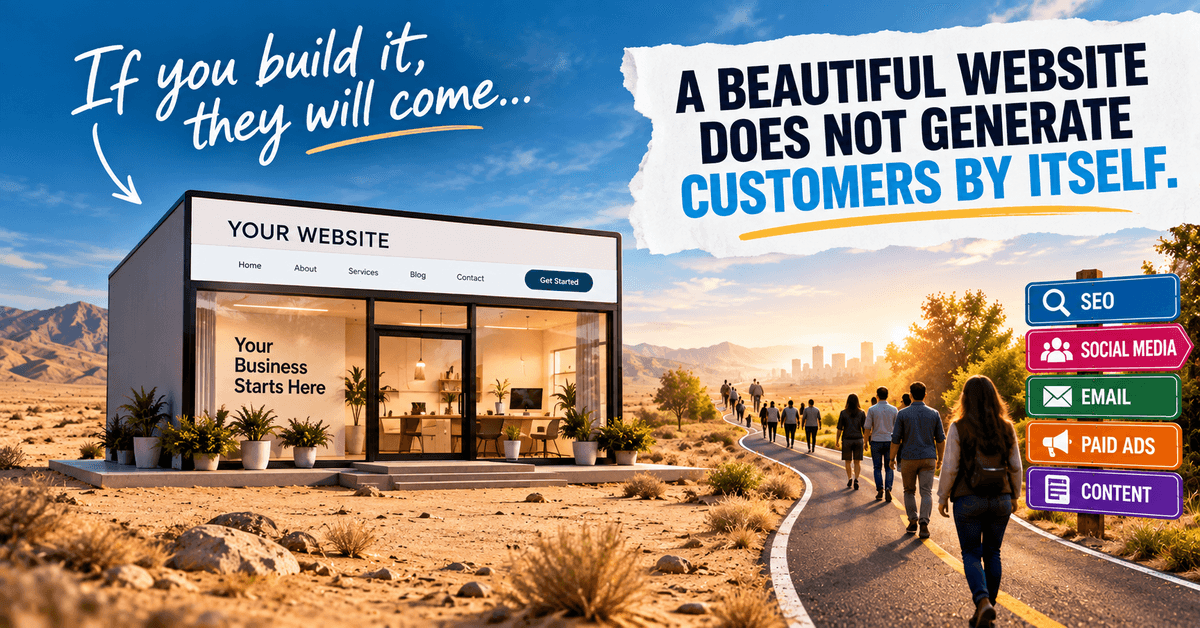
“If you build it, they will come.”
It’s one of the most familiar ideas in business — and also one of the biggest misconceptions for small business owners launching a website.
A professionally designed website gives your business a strong online foundation, but a website alone does not automatically generate traffic or customers. It is not a complete marketing plan or lead generation system by itself.
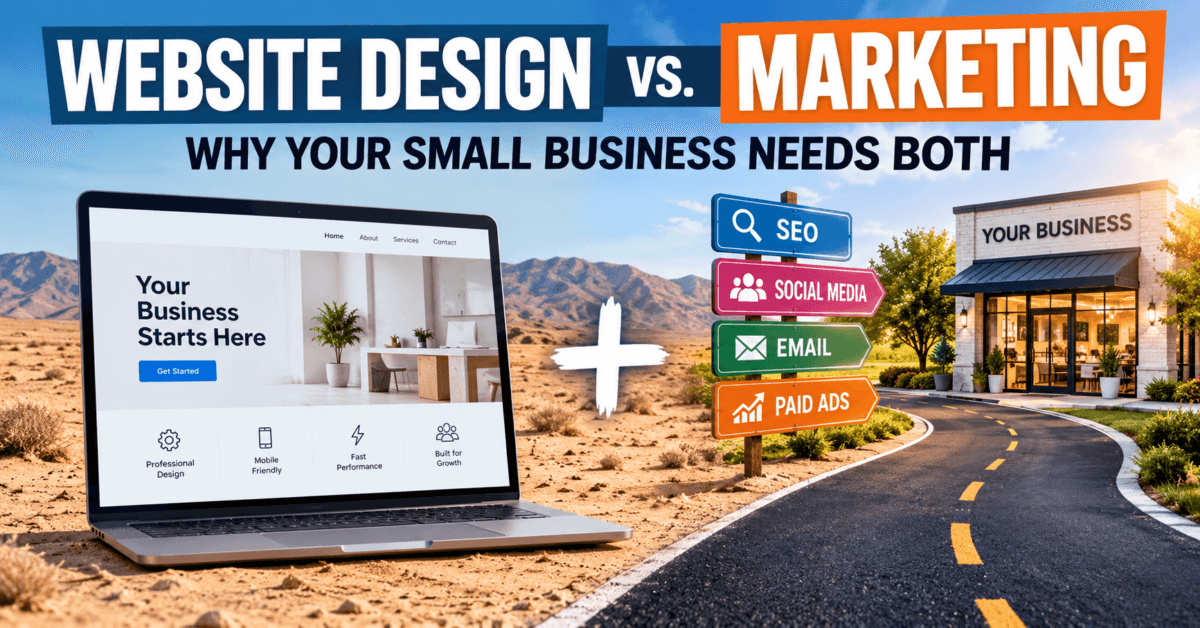
Think of your website as your digital storefront. It gives potential customers a place to learn about your business, understand what you offer, build trust in your brand, and take the next step.
But first, they have to find you.
That is where marketing comes in.
Many business owners invest in a professional website, launch it, and understandably expect people to start visiting. When weeks or months pass without the traffic or inquiries they expected, they may begin wondering whether something is wrong with the website.
Often, the website is doing exactly what it was designed to do.
What may be missing is the strategy for bringing people to it.
Website Design and Marketing Are Not the Same Service
This is an easy distinction to miss, especially when you are starting a business and trying to coordinate several different services at once.
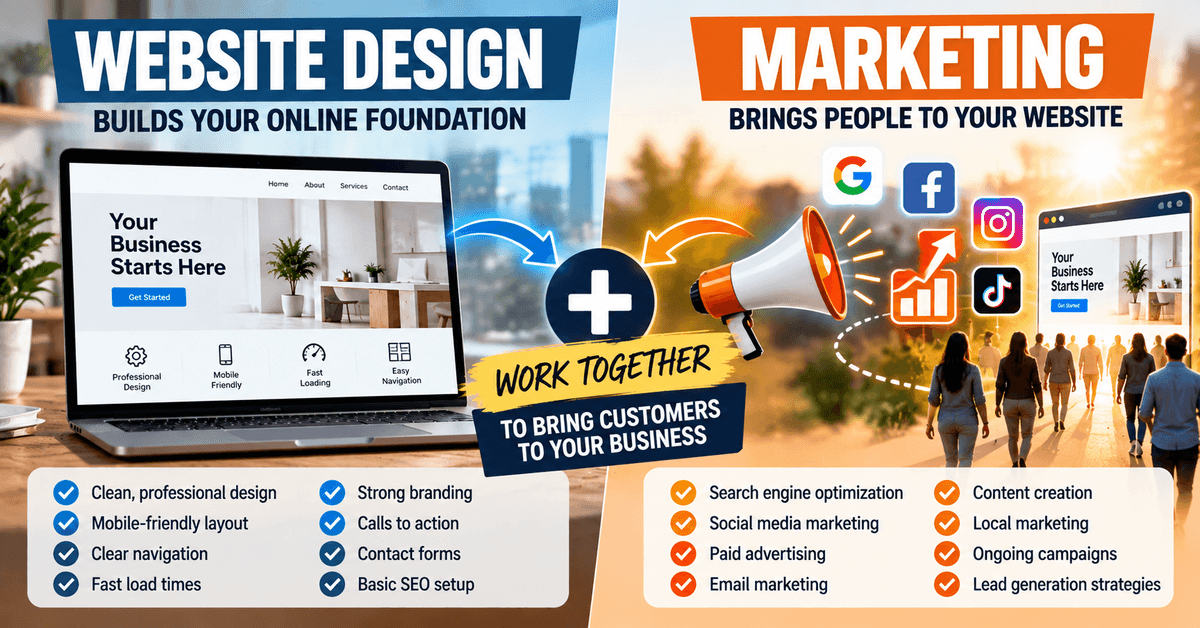
Website design and marketing are closely connected, but they solve two different problems.
Website design focuses on creating the online foundation for your business.
That can include:
- Professional design and branding
- Mobile-friendly layouts
- Clear navigation
- Fast-loading pages
- Calls to action
- Contact forms
- Basic search engine optimization
- A user experience that makes it easy for visitors to understand what you offer
Marketing focuses on attracting people to that foundation and encouraging them to take action.
Depending on the business, that might include:
- Search engine optimization
- Social media marketing
- Paid advertising
- Email marketing
- Content creation
- Local marketing
- Search advertising
- Ongoing campaigns and promotions
The two work best together.
A beautifully designed website without a plan for generating awareness can be like opening a great storefront on a road very few people travel.
On the other hand, spending money on advertising and marketing while sending visitors to a confusing, outdated, or slow website can waste valuable marketing dollars.
Ideally, website development and marketing should be considered part of the same overall business plan from the beginning — even if your budget requires you to build them out in stages.
Where Startup Remedy Fits In
At Startup Remedy, our focus is helping businesses build the foundation they need to establish a professional online presence.
We help with services such as website development, basic SEO setup, social media profile setup, and other essential pieces businesses need when getting started or improving their existing online presence.
Our goal is to make sure you have a professional foundation to build on.
Ongoing traffic generation, paid advertising, extensive SEO campaigns, content marketing, and long-term growth strategies are different services and may eventually require a dedicated marketing specialist or agency.
Understanding that distinction from the beginning makes it much easier to plan your budget, set realistic expectations, and decide what your business needs next.
And once people do start finding your business, there is another important piece of the puzzle.
The Follow-Up Gap Nobody Talks About
Let’s say you have both pieces working.
Your website looks professional, and people are beginning to visit it.
That is great — but traffic alone still does not guarantee customers.
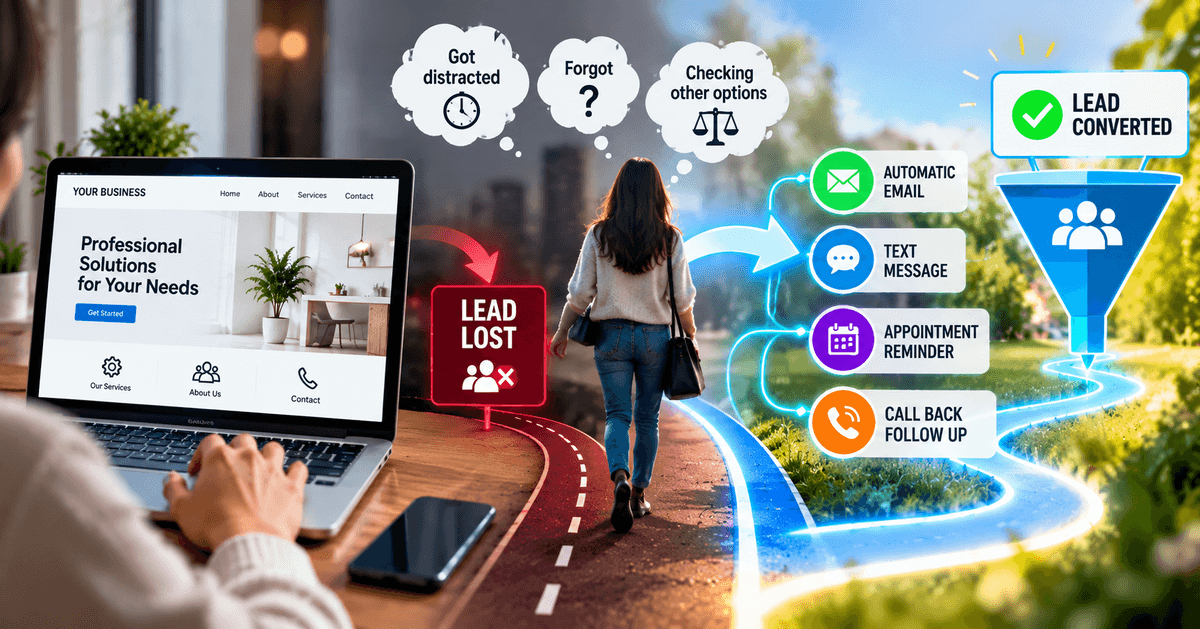
Someone might visit your website, read about your services, fill out a form, start a chat, or call your business.
Then life happens.
They get distracted.
They forget to respond.
They decide to “come back later.”
Or they contact several businesses at the same time and simply choose the one that responds first.
Without a follow-up system, interested prospects can disappear surprisingly quickly.
I have seen this happen firsthand with clients.
One client had a professionally designed website and traffic coming in, but there was no consistent system for following up with people who submitted an inquiry.
Leads would come through the website, but if someone could not respond immediately, valuable time could pass before the prospect received a reply.
By then, the potential customer might have lost interest or contacted another company.
Another client had a similar challenge with phone calls.
If someone called and the business missed the call, there was no automatic text response or reminder prompting someone to follow up.
For many service-based businesses, those missed calls represent real opportunities.
The solution in these situations was not redesigning the website.
It was improving what happened after the lead arrived.
We built automated follow-up funnels using GoHighLevel and WordPress.
When someone submitted a form, missed a call, or booked an appointment, the system could automatically trigger actions such as a text message, follow-up email, appointment confirmation, or callback reminder.
Instead of relying entirely on someone remembering to manually follow up with every inquiry, the business had a system helping move the conversation forward.
Why Follow-Up Automation Matters
This is one reason I recommend GoHighLevel for certain small businesses.
It can bring several parts of the follow-up process — including email, text messaging, appointment communication, and callback reminders — into one platform.
For a small business without a dedicated sales team, automation can help make sure potential customers receive timely communication.
It does not replace good customer service.
It supports it.
The goal is not to automate every conversation. The goal is to make sure opportunities are not being lost simply because someone forgot to send an email, return a call, or follow up with an interested prospect.
If you want a more detailed explanation of how GoHighLevel works and whether it might be appropriate for your business, I have also written a full review of the platform.
Customer Service Is Part of Your Marketing
Marketing does not necessarily end once someone contacts your business.
The experience you provide afterward can become part of your marketing too.
Think about the customer’s experience.
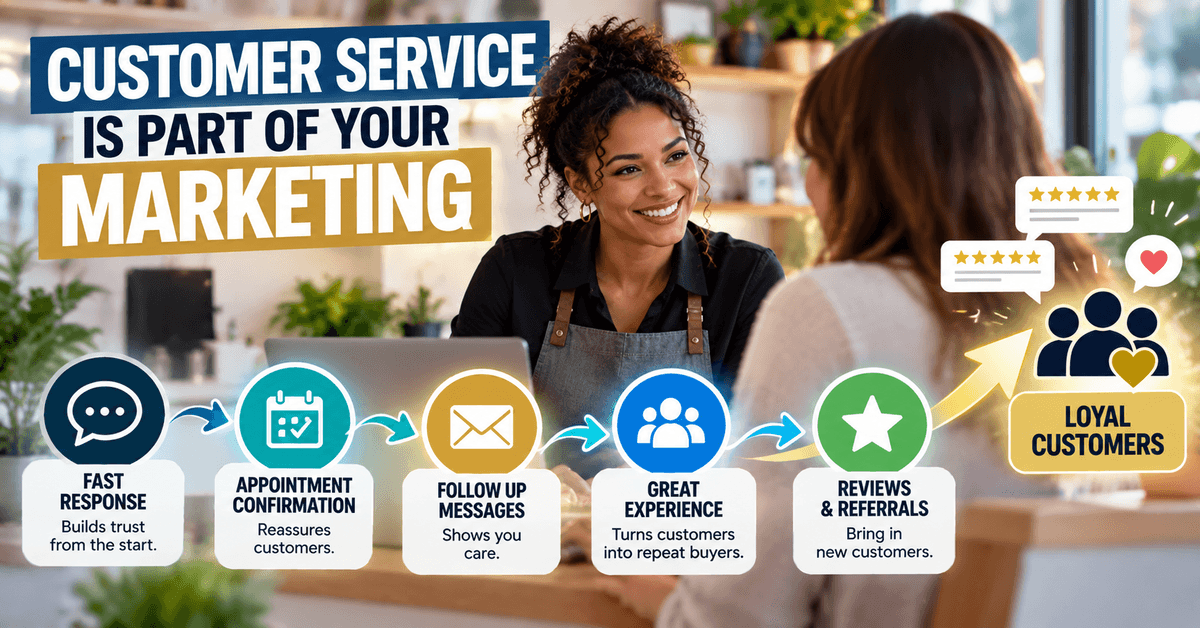
A fast, helpful response to a question can build trust before they spend a dollar.
An appointment confirmation can reassure someone that their booking was received.
A follow-up message after a service can show customers that their experience matters.
A review request can turn a satisfied customer into social proof for future customers.
And great service can turn a first-time customer into someone who comes back or recommends your business to others.
Every one of those interactions influences how people perceive your company.
That perception can lead to reviews, referrals, repeat customers, and word-of-mouth recommendations.
Automation can help here as well.
Appointment reminders, confirmation messages, review requests, follow-up emails, and customer check-ins can all become part of the same system used to nurture new leads.
Instead of thinking about your website, marketing, follow-up, and customer service as completely separate activities, it can be helpful to think of them as different stages of the same customer journey.
Don’t Wait Until Launch Day to Build Your Online Presence
Another common mistake is waiting until the website is finished before thinking about social media or online visibility.
You do not necessarily have to wait.
If you are preparing to launch a new business, you can begin establishing your online presence while your website is being built.
Share the process.
Talk about the problem your business is preparing to solve.
Post photos of products, your workspace, completed projects, preparations, or behind-the-scenes progress.
Introduce your services.
Answer common questions.
Give people a reason to become familiar with your business before you officially launch.
You may hear this referred to as building in public.
The idea is simple: instead of appearing online for the first time on launch day and immediately asking people to buy something, you allow potential customers to become familiar with your business beforehand.
And you do not have to become a content creator or spend every day making videos to do it.
You do not have to be on camera if you are uncomfortable doing so.
A simple photo with a useful caption can work.
So can a graphic, project photo, product image, customer question, quick tip, or behind-the-scenes update.
The goal is simply to start showing up where your potential customers already spend their time.
Consistency matters more than trying to make every post perfect.
Then, when your website officially launches, your business is not necessarily introducing itself to everyone for the first time.
You have already started building awareness.
The Bottom Line
A website and marketing have different jobs, but they work together.
Your website is the foundation.
It gives your business a professional online home and gives potential customers somewhere to learn about what you offer.
Marketing creates awareness and brings people to that foundation.
It helps potential customers discover that your business exists.
Follow-up helps turn interest into conversations and opportunities.
It keeps leads from disappearing simply because someone did not respond at the right time.
Customer service helps turn customers into repeat customers, reviewers, and referrals.
Together, these pieces create a much stronger online presence than any one of them can create alone.
That does not mean every small business needs to invest heavily in every area on day one.
It does mean you should understand the role each piece plays so you can plan for them as your business grows.
A professional website is an important investment.
But launching the website is not the finish line.
It is the foundation you build the rest of your online strategy on.
At Startup Remedy, our role is to help you get that foundation right.
If you are not sure where your business currently stands — or whether you are missing the website, online presence, or follow-up pieces needed to support your next stage of growth — reach out and let’s take a look at what you already have and what may make sense to add next.
Frequently Asked Questions
Do I need a website designer or a marketing agency?
Website development and traffic generation are typically separate services unless marketing, advertising, ongoing SEO, or traffic generation is specifically included in your agreement.
Many businesses eventually benefit from both, but the services serve different purposes.
A website designer or developer creates the online foundation for your business, while marketing professionals focus on generating awareness, attracting traffic, and promoting your products or services.
They do not necessarily need to come from the same provider, and you do not necessarily need to invest heavily in both at the same time. What matters is understanding the difference and planning for both as your business grows.
Should my website designer be responsible for bringing traffic to my website?
Not necessarily.
Your website developer’s role may include building a search-friendly, mobile-friendly, professional website and completing basic SEO setup. Ongoing traffic generation generally requires additional marketing activities such as SEO campaigns, advertising, social media, email marketing, content creation, or other promotional strategies.
This is why it is important to understand exactly what is included when hiring a website provider.
What is follow-up automation and why does it matter?
Follow-up automation uses systems to automatically communicate with leads or remind your team to follow up.
For example, someone who submits a website form might immediately receive a confirmation text or email. A missed phone call might trigger an automatic text response. An appointment could trigger confirmation and reminder messages.
These systems help reduce the chance of interested prospects being overlooked.
Why do you recommend GoHighLevel?
GoHighLevel combines several tools that small businesses often use separately, including email communication, text messaging, appointment management, lead tracking, and automated follow-up workflows.
For businesses that receive leads through their website, calls, forms, or appointments, having these functions connected can make managing follow-up easier.
The right platform depends on the individual business, but for businesses that need stronger lead follow-up without hiring a dedicated sales team, it can be worth considering.